
Your Databricks partner in Montréal.
We set up the platform and move the data that feeds it. The work ends when your teams use it without us in the room.
Platforms we build on








What we do on Databricks
Most engagements start with one of these and pull in the next.
We stand up your workspaces and put Unity Catalog in charge of who sees what, down to the column. Access rules, lineage and audit come from one place, so a new table arrives governed instead of being governed six months later.
We move the pipelines, the history and the reports in a sequence that keeps month-end running while the move happens. Lakebridge carries the conversion of the existing SQL and jobs, Lakeflow carries the ingestion, Delta Lake holds the tables, and your existing Power BI reports keep pointing at something real.
A finance or operations person asks a question in plain language against governed data, and every answer shows the SQL it ran, so it can be validated. Genie Agents hold the context for one subject area and AI/BI dashboards carry the recurring views. It only works when the model underneath is clean and each metric is defined once, which is most of what we do before we turn it on.
Agent Bricks and Mosaic AI put agents next to the data instead of next to a copy of it, and MCP connects them to the systems your teams already use. A person reviews what matters before anything is sent, approved or posted. That check is part of the design.
A platform goes in and the value stays with the technical teams, because managers and analysts keep exporting extracts to Excel. Copies mean one metric with two values; dependency means days of delay for a simple question. Databricks One gives a business user one place to open a dashboard, ask Genie a question or run an app, with no workspace to learn first, and we train the people who ask the questions on it. Excel and Power BI stay your tools, connected live to the governed platform instead of fed by copies, and the measure is a business user answering their own question and able to validate it.
One governed source across ninety brands.
Every brand ran on its own numbers and its own definition of the same metric, so the close was an argument before it was a report. Databricks gave everyone one governed source with consistent metrics.
We built the platform and drove adoption across IT, procurement, legal and accounting, each of which had to change how it bought, reviewed or closed before the platform counted for anything.
Delivered by members of the founding team in prior operating roles.
Change management ran alongside the build from week one.
A platform only the technical team opens changes nothing for the business: the managers who decide still wait days for a number, and still argue about which version of it is right.
A team in Montréal, close to Databricks.
Local and bilingual
The whole team works out of 1188 Union in Montréal. Delivery, training and documentation happen in French or in English, whichever your team reads.
Certified and current
Databricks certification and continued training are part of how we staff an engagement, aimed at the features that carry the value: Unity Catalog, Lakeflow and Jobs, Delta tables, MLflow. The people who design your platform are the ones who build it.
A line into Databricks
We share clients with Databricks and work with their account teams and solution architects, so a question that outruns the documentation gets an answer in days.
Active in the Databricks community.
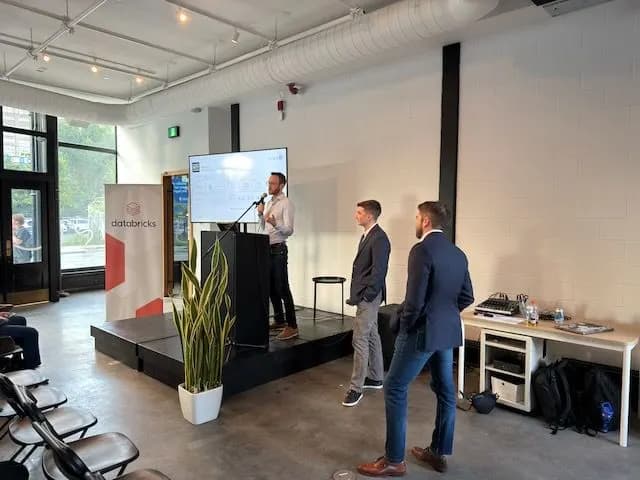
Jean-Philippe and Hugo presented at the tenth edition of the Montréal Databricks User Group, on how MTY Food Group’s Data & AI Hub was built and grown on Databricks.
We take part in the Databricks events held in Montréal, and what we bring to them is the work itself: how a build was run, and what it cost to run.
Privileged access
What the partnership opens up for your build. You own the account, the data and the code, and we do not resell licences.
Best practices
Case studies from your own sector, so a design decision starts from what already held up somewhere it mattered instead of from a blank page.
Accelerators
Templates that reproduce implementations already shipped, so the common pieces of your build are assembled rather than written again.
Product roadmap
The latest releases and the roadmap behind them, so what we design this quarter still fits what ships in the next one.
Questions
All three. Databricks runs on each of them, and the right one is usually the cloud your organization already buys, secures and staffs. If you have no incumbent, we pick on data residency, existing identity setup and cost.
Yes, once the data model behind it is defined. A finance user asks in plain language and gets an answer with the generated query shown, so it can be checked. Before we turn it on, we agree metric definitions with your team, because Genie answers from what it is given.
Sometimes not, and we will tell you so. Power BI stays either way, pointed at governed tables instead of Excel exports, which is where the lineage problem actually sits. From Synapse, moving to Fabric and moving to Databricks cost about the same effort, so the comparison is the destination, and Fabric is the honest answer for a shop already committed to the Microsoft stack. A Snowflake that works is worth keeping unless heavy AI and data science are coming to the same data.
It can be. Databricks offers Canadian regions, and we scope residency, including Québec requirements, at the start of the engagement rather than at the end. We write down which data classes may leave the country, and Unity Catalog enforces it rather than a policy document.
The diagnostic is 30 days. A first production use case after it usually runs two to four months, depending on how many source systems are involved and how clean the definitions are. We would rather ship one governed subject area finance trusts than a wide platform nobody queries.
Your cloud subscription and Databricks itself, and nothing from us beyond the engagement. We do not resell licences, so there is no margin steering our advice. If an existing tool covers a need, we tell you to keep it.